

How do Hatchling and Juvenile Mediterranean Tortoises Really Behave in the Wild and What Humidity Levels do they Really Experience? Myth Busters Episode 12


Andy C. Highfield
We have covered this general topic several times, from various angles, and we have also attempted to set the record straight by answering questions on various tortoise keeping groups and forums over many years. Unfortunately, no matter how many times we provide verifiable, factual and accurate information on the subject the same incorrect, misleading and distorted misinformation continues to be repeated and copied all over the place. It is always very confidently cited as being based upon fact. It is usually no such thing, however, and is a very long way indeed from how these animals really behave or the conditions that they live in. As usual, we will start by quoting some examples so you can see what we are dealing with here. All of this "information" and advice has appeared in hundreds of social media groups and forums over the past year or so posted by various group "experts".
We hope that this comprehensive article, with full supporting data, numerous photographs and video (coming soon) will help, finally, to conclusively establish the truth. We are also aware, however, that quite a number of these groups actively ban and prohibit their members from posting links to referenced articles, or even quoting facts from outside of their own group. This is, of course, not how science works at all and is extremely counter-productive, perpetuating falsehoods, ignorance, and ultimately, directly harming the very tortoises that they purport to help. Make no mistake. Forcing tortoises from arid habitats to live in conditions better suited to a tropical Hingeback tortoise, for example, will invariably have negative impacts upon health and quality of life, as would the reverse.
We do not underestimate the difficulty of overcoming such a situation, but we do feel very strongly that this ever-expanding tsunami of dangerous misinformation does need to be confronted directly.
All of the advice quoted below was intended for keepers of Testudo species (Mediterranean tortoises) though almost identical misinformation is frequently seen offered to keepers of other arid and semi-arid species such as Leopard tortoises (Stigmochelys pardalis) and African Spurred tortoises (Centrochelys sulcata). In the case of these species, of course, the annual cycles are different and the climatic conditions are not identical, however, the same false assumptions are often made and the the bulk of advice given typically does not accurately reflect reality.
"You can keep adults on a tortoise table, but babies need to be in moist coco-coir or sphagnum moss for at least 3 years as in the wild they rarely leave the thick, damp vegetation".
Above: In early May, a wild hatchling from the hatch in the previous September grazes and basks in the open. Note that the substrate and general environment are incredibly dry and are about as far from sphagnum moss or moist coco-coir as could possibly be imagined.
"If a tortoise of less than 18 months old leaves the protection of the humid vegetation even for a short time it will likely die from dehydration very quickly"
"Adults and juveniles inhabit completely different habitats and microclimates".

"Because of the dangers of predation and because they will die from dehydration if they leave the thick and moist layer of vegetation, young tortoises spend as much as 80% of their early lives partly buried in damp plant roots".

"Keeping hatchlings or juveniles in anything less than 60% of humidity is a guaranteed death sentence. 80% is optimal".
"To avoid dehydration and also pyramiding you MUST use a moist substrate that they will bury into such as moss or coco-coir. In the wild you will never find juveniles in dry habitats as it would soon kill them or cause them to grow deformed".

Not very moist or humid... this stark habitat supported a surprisingly healthy population of Testudo graeca graeca with a good distribution of ages, from very small juveniles to quite large adults (Morocco). 
A reasonable indicator of just how arid some tortoise habitats really are. Yes, this really is Testudo graeca habitat. We can positively guarantee there are zero areas of "moist" vegetation or of "damp" substrates here.

"Babies hatch during the rainy season"
"Don't just rely upon a moist substrate, as it might dry out too much. The use of closed chamber with at least 80% to 90% humidity at all times, day and night, for at least 2 years is far better and safer. You cannot grow smooth tortoises without high humidity".

There are now even commercial enterprises peddling this bizarre stuff for profit:
"Reptile Tents is the home of the first “Tortoise Hatchling Habitat”. This is a closed chamber reptile enclosure to be used for “hatchling tortoises”. We believe that by keeping an 80/80 rule. 80% humidity and 80-degree ambient temperature with a 95-degree HOT SPOT we can “wipe out pyramiding” in are (sic) young tortoises".
We have news for "Reptile Tents". Incredibly, they wiped it out all by themselves countless millenia ago without ever needing any such conditions. They still do so today and there are also a great many people breeding and raising perfectly-formed healthy tortoises in captivity using far more natural and less harmful methods.
There is, unfortunately, much more of this mind-boggling stuff where that came from but these comments and attitudes are entirely representative of the type of nonsense which is endemic in many of these groups. Even more unfortunately, it is usually accepted as true without question and repeated ad-infinitum.
Let us look briefly at each of these points and contrast them to the reality:
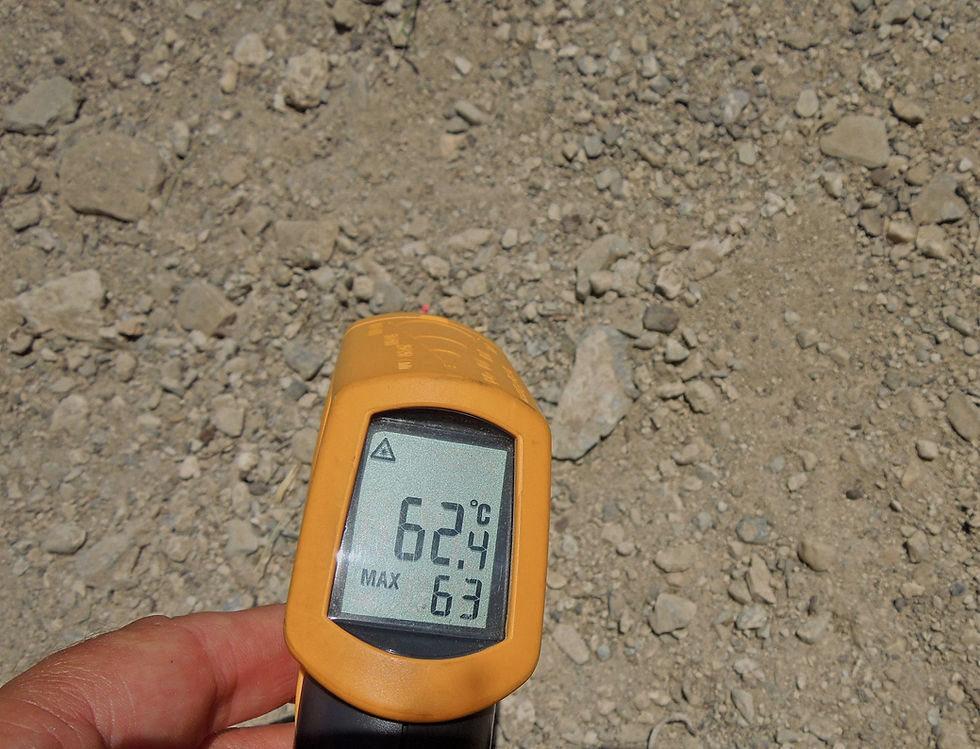
Damp substrates of any variety are categorically not what these species really live on in nature. The only time these substrates are ever wet or damp is during or just after rain - which is quite a rare event for much of the year, or after heavy ground mist or dew. It then dries up very quickly under the intense heat of the sun. As for "you will never find juveniles in dry habitats only moist" that is completely untrue as would be immediately obvious to anyone who has ever really studied tortoises in these areas. They are semi-arid habitat species. That literally means exactly what it says. Not quite a full desert technically, but not too far removed either. There are strong seasonal variations in vegetation, with early to mid-spring bringing the peak of vegetation, but this only persists for a relatively short period. By late spring, and certainly by summer, there is barely any green to be found. The substrates too are very dry combinations of sandy and stony with some fine silt. Ground surface temperatures in August can surpass 70 degrees Celsius ( 158 degrees Fahrenheit). The tortoises aestivate throughout this period. None of them live on or in anything remotely resembling coco-coir. See photos below of what these substrates are really like. Indeed, we have reported separately on the use of coir and included precision measurements on the totally unsuitable conditions that it creates for these species: "Coco Coir Substrates for Testudo Species".
The suggestion that tortoises of less than 18 months of age will "die from dehydration very quickly" if they leave their (non-existent) "humid hide" is just plain silly, displays a shocking ignorance of animal biology and ecology, and totally understates just how well these remarkable animals are adjusted to live in harsh and challenging environments. They have various physiological adaptations that allow them to concentrate nitrogenous wastes in a water-efficient manner (urates) and their bodies and structure are ´designed´ to conserve fluids and reduce fluid losses. They do not need "humid hides". Simply burying down into even very dry substrates which dramatically reduce evaporative losses and reducing their metabolic rate is more than adequate. It should come as no surprise that other animals also employ identical strategies, for example the Desert Spadefood Toad (Notaden nichollsi). To adapt to the extreme arid conditions that this Australian amphibian occurs in, they have developed specialised adaptations, including the ability to burrow below the soil surface, undergo physiological and biochemical changes that massively reduce reliance upon water and engage in aestivation during the long, hot dry periods. Exactly as many tortoise species do.
It is also completely untrue that hatchling and juvenile tortoises "rarely" emerge from vegetation. They actually follow very similar behaviour patterns to adults.
There are slight differences due to how body mass affects thermoregulation and hence activity (a 750g tortoise warms and cools much less rapidly than a 25g juvenile) but overall their behaviour patterns are essentially the same. They emerge in the mornings to graze, they retreat when it becomes too hot, or too cold, and they experience the exact same environmental conditions as adults at the same location. Think about it... they actually have to emerge into the open to bask effectively and to gain adequate exposure to UV-B, and indeed they do. They categorically do not spend 80% of their lives sheltered and hidden. They are very cryptic ( they blend in very well in these habitats) and are incredibly hard to find, even for predators. If you have ever lost an adult in your own garden, imagine the difficulty of locating juveniles in this:

Adults and juveniles absolutely do not "inhabit completely different habitats and microclimates". Hatchlings emerge (usually in September) from eggs laid in April-May. These nests are of course laid by the adult females in their habitual habitat. We frequently find adults, new or last years hatchlings and a range of juveniles of varying ages literally next to each other or short distances apart. They do not hatch from their eggs and then jump on a bus and relocate elsewhere.... like so many of these myths and fantasies, if only people applied a small amount of basic natural history knowledge and some common sense it would be obvious just how irrational and improbable such claims really are. Even better, take a trip yourself and visit some natural tortoise habitats. So many people these days rely on Google and AI when even a few days of first-hand experience would really open their eyes.
If exposing hatchlings and juveniles to anything "less than 60% of humidity is a guaranteed death sentence" then wild Mediterranean tortoises would not exist in the first place and they would be all deader than Monty Python´s iconic parrot, because they are routinely exposed to relative humidity levels well below 30% when grazing and basking, and even when in retreat in vegetation or hides RH levels of circa 40% are entirely typical. We have attached tiny, coin-sized data loggers to such tortoises and tracked them for days at various locations from Morocco and Tunisia though Spain, France, Italy, Greece, Turkey and beyond. The results are remarkably consistent. For one of our early reports of humidity levels in hides and burrows see "Observations on ecological changes threatening a population of Testudo graeca graeca in the Souss Valley, Southern Morocco" (Highfield and Bayley, Chelonian Conservation and Biology, 1996).

Babies do not "hatch during the rainy season" (at least in the case of Testudo species) for the very simple, fundamental reason that there is no "rainy season". These are not tropical habitats. They are temperate semi-arid habitats. In brief, the eggs are laid in late spring, and then they incubate throughout the long, hot incredibly dry summer. As the summer heat finally breaks this is indeed often accompanied by a heavy thunderstorm. This prompts emergence. However, it can then be many weeks before it rains again and meanwhile it is very hot and dry. By late December the hatchlings dig down to brumate, emerging again in Feb-March. The heaviest seasonal rainfall actually occurs in early spring, which renews the vegetation. There is asolutely nothing that remotely resembles a tropical rainy season. We have several very good videos on this. See our YouTube Channel.

Typical temperature and RH range during activity periods. Once ambient temperatures surpass 32°C tortoises seek shade. By mid-day late in spring or early summer ground surface temperatures regularly exceed 60°C (140°F) which would rapidly overheat any tortoise subjected to it. At these times tortoise activity is restricted to very early in the morning before temperatures rise. Eventually, even then it is too hot and there is zero access to food or water, hence, they aestivate. Apologies, but no-one comes to give them daily "soaks" either....
So-called "pyramiding" is a complex issue. We have described the actual mechanisms involved, including any environmental impacts at length, many times, in far too much detail to include here. See for example "Tortoise Shell Deformities: A View from the Inside" and "Pyramiding: Misunderstandings, Misrepresentations and some very strange research methods"
In a nutshell, however, "pyramiding" in tortoises is caused by a combination of factors including: excess rates of growth and an incorrect nutitional balance (especially an excess of phosphorus and lack of calcium) often combined with inadequate UV-B resulting in poor bone density, in conjunction with over-drying and thickening of the keratin layer surrounding the carapace which results in powerful upward forces being applied during lateral keratin cell deposition and the consequent "warping" effect upon the essentially plastic skeletal bone beneath. Artificial heat lamps and their adverse IR spectra compared to natural water-filtered solar IR are heavily implicated. See "How Heat Lamps can Harm the Health of Tortoises and Contribute to Growth Deformities".
Incidentally, before we published our ground-breaking research into the real causes in 2010 no-one else had ever correctly identified the mechanisms involved. All kinds of strange theories were proposed. Even now, many still fail to understand it and frequently misinterpret it.
Those are just a few of the very many myths, misundertandings and misconceptions that flood social media and pet tortoise keeping communities. There are many more, but we cannot cover them all here. We actually live full time in a country with native Testudo graeca and Testudo hermanni populations. We have spent many years studying them in all seasons and at all phases of their lives. We have also spent 40 years studying tortoises of many other species all over the world, not just in captivity, but in the wild in their natural habitats. Their ecology and biology is amazing. Rather than misrepresenting this to fit narrow preconceptions, would it not be far better to approach the subject with an open mind and learn from it?
Some objective facts:
The core defective belief behind most of these myths is that somehow, even in the very hot, dry climates inhabited by Testudo species, there exist some forms of "humid hides". Actually, if you seriously think this through it should be fairly obvious that this would require some kind of miracle, as there is frequently very little rainfall per year (hence arid habitats!) combined with very high temperatures and drying winds. In such conditions, water and moisture evaporates, and does so very quickly. This is most obvious as relative humidity rises in the cold early hours of the morning, just before dawn and as the dew point is reached. Water vapour then precipitates from the air as dew and also forms ground mists. It evaporates very rapidly after sunrise, however. We have covered this irrational but pervasive belief in "humid hides" previously in Myth Busters Episode 6 in considerable detail and explained why they simply do not exist in the form so many believe: Do semi-arid habitat tortoises use 'Humid hides' in the wild? Are they necessary in captivity? Does the 'closed chamber' method have any rational basis?
That really does set out the facts and provides genuine, objective data collected in the field and also demonstrates that yes, you certainly can raise healthy perfectly-formed captive-bred tortoises without resorting to such unnatural methods.
However, despite this, the same nonsense continues to appear again and again, so this time we thought we would invite you to join us over a full season of tortoise activity when we aim to gather a whole new set of readings taken in actual tortoise habitats at a variety of locations, specifically focussing on these particular false claims:
That wild Testudo species make extensive use of "moist", "damp" or "humid" patches of grass or other vegetation to avoid "dehydration".
That relative humidity levels of approximately 80% (no temperatures are typically cited) are sustained in these alleged microclimates.
As a first instalment, and to demonstrate the methodology, we visited one of our regular study sites and planted a calibrated, precision temperature and relative humidity data logging device in the greenest area of vegetation we could find.
This is the site in question, showing the exact position of the recorder:

Here is a quick snapshot of the temperatures and relative humidity levels recorded at that precise point:

We also located a juvenile hidden inside a clump of esparto grass in the same general vicinity. Again, remember, recorded following the wettest winter in 30 years and only 72 hours after heavy rain.

Two important points here: 1) This has been the wettest winter-early spring here in over 30 years, so a great opportunity to record relative humidity levels at their all-time highs in recent history in particular microclimates (this is merely one quick example, we have multiple sets of data being collected concurrently). 2) This is a very typical retreat for Testudo graeca graeca and similar conditions have also been experienced throughout North Africa this year (Morocco, Algeria, Tunisia). 3) According to very vocal and insistent "experts" on social media tortoise keeping groups we should certainly expect to find RH levels in these retreats of "80-90%". Of course that is complete nonsense. You can see the real levels here for yourself. These readings are totally typical and consistent with thousands of other similar readings we have gathered over very many years in Morocco, Tunisia, Spain, Southern France, Italy, Greece, Egypt and Turkey. 4) A helpful rabbit had excavated a dig that clearly reveals the very sandy, light, and well-drained nature of the substrate just beneath the surface. No coco-coir here. No damp sphagnum moss, and of course, no, they do not get "impactions" from the sand either.


Those are just two brief snapshot readings but we have other recorders taking long-term measurements and we hope to supplement this article with additional readings for each month during 2026. We have previous detailed records from other years, however, for example, this long-term recording from June 2025 measured over 18 days.

Here is a similar set of data with the prevailing weather conditions overlaid to assist interpretation:

CONCLUSION:
There is no factual basis whatsoever for claims that these tortoises remain for extended periods in warm "humid" or "moist" microclimates that offer relative humidity levels of 80-90% on a constant basis. The only time RH rises much above 50% is either overnight in the early hours as dew forms where this is accompanied by lowered ambient temperatures, or during or shortly after episodes of rain. Typical levels of RH in microclimates and habitats during both activity and retreat range from 23% to 40% at ambient temperatures from 18‘C to 31‘C.
Important Notes
It is vital to understand that 50% of relative humidity means something totally different in colder air than it does in warmer air. This is a source of much confusion. Also, citing a relating humidity percentage alone, without the temperature it was measured at is essentially meaningless. 50% RH at 12‘C means the air is holding 4.44g of water per Kg of air. 50% RH at 30‘C however translates to 13.63g per Kg of air - three times as much! This makes a huge difference to how various levels of humidity "feel" (and the effect upon tortoises). So, you can have quite high percentage numbers during a cold rain, and it still feels comfortable. Yet, that same percentage in a hot forest will feel very oppressive. Levels such as the often suggested 80% to 90% RH at 30‘C are actually typical of what you find Green Iguanas living in deep in the tropical rainforests of Costa Rica! We know. We´ve been there and measured it ourselves.
Both relative humidity and absolute humidity measure the water vapour level in the atmosphere. However, it is worth noting that absolute humidity does not take into account the air temperature. It only depends on the amount of water vapour. Relative humidity, on the other hand, depends on the air temperature. We express relative humidity as a percentage, whereas absolute humidity is expressed in units of g/m3 or kg/m3. We have an excellent detailed article for more information: Understanding Humidity for Tortoise Keepers
We used a variety of professional grade data loggers and temperature-humidity meters in these studies from Fluke, Testo, Elitech and Signatrol Ltd. All were calibrated and were checked for accuracy regularly. If you wish to do your own tests or check level in captive situations we strongly recommend avoiding ´no-name´ cheap models. They are often wildly innaccurate. Professional equipment will come with an individual certificate of calibration,
To be clear. We are not recommending that you expose tortoises to very low levels of RH under artificial heat lamps. There is a vast difference in the dehydration, heating and drying effects of artificial sources in small enclosures and natural solar infra-red in the wild. We discuss this separately: How Heat Lamps can Harm the Health of Tortoises and Contribute to Growth Deformities.
Equally, we do have practical advice on dehydration, causes and prevention in another detailed article that you might find helpful: Hydration and Your Tortoise
As you can imagine, conducting genuinely original research like this takes a very long time to conduct (months and years), involves a great deal of travel, is very time consuming, and also requires the use of some very expensive equipment indeed. If you would like to see more of this, we really would appreciate it if you could make a donation or subscribe. It really helps. We have been established since 1984 and we continue to provide original research and reliable information to tortoise and turtle enthusiasts worldwide. We also have two excellent online courses available, one for beginners and new keepers and one for advanced and professional keepers. These cover some of the background science that is key to truly understanding and appreciating tortoises and turtles and are also extremely practical. We have taught in colleges and universities around the world, and have trained private enthusiasts, wildlife rangers and conservation staff for many years.
All text & photos: (c) A. C. Highfield/Tortoise Trust


