

Coco Coir Substrates for Testudo Species: Myth Busters Episode 10: UPDATED

Updated: 3 days ago

A. C. Highfield
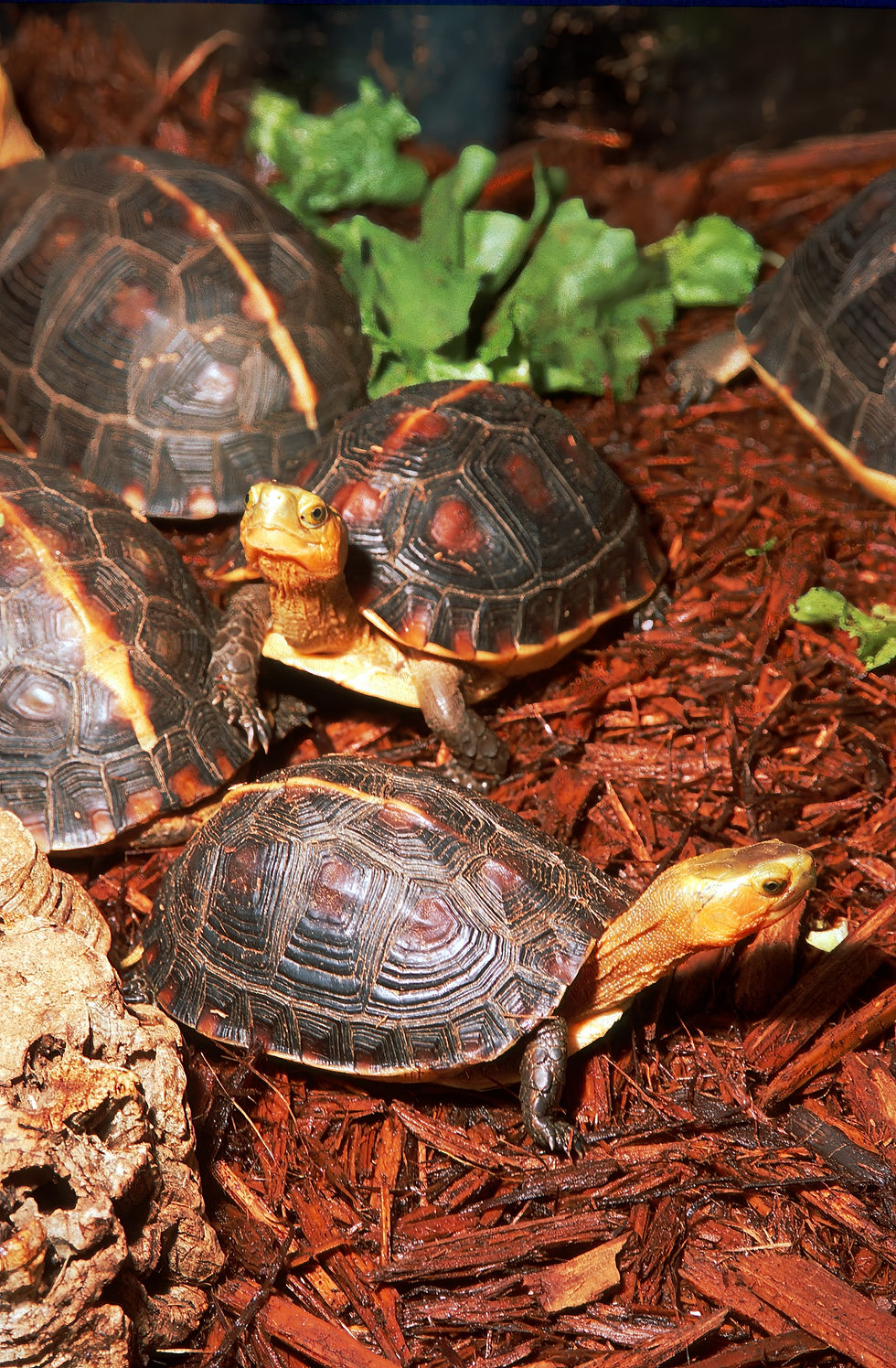
A relatively recent phenomenon (within the past 15 years), apparently driven by advice and recommendations on social media groups and internet forums, is the use of coco coir as a substrate for Mediterranean tortoises and related Testudo species such as the Asian Testudo horsfieldii (Russian tortoise). It is also often recommended for other arid habitat species such as Centrochelys sulcata, the African Spurred tortoise. It is heavily promoted by the pet tortoise trade as it is a high profit line with the prospect of repeat sales. Those of us who have been involved with tortoises and turtles for many years might find this surprising, for a number of reasons. We will also note that just a few years ago this was barely even mentioned as a substrate for these species, although some keepers of tropical turtles such as the Asian box turtles (Coura sp.) were certainly using it in combination with leaf litter and orchid bark to create high humidity environments that are well-suited to such species.
What is it?
Coco-coir is an industrial/agricultural byproduct made from the fibrous material found between the outer part of a coconut and the hard internal shell. It has a long history of use for making doormats, brushes and ropes. In finely ground form it is used as an agricultural substrate, and it is particularly favoured for growing mushrooms. Naturally, many sources are extremely high in salt and potassium content, and therefore much of the coir sold has been washed and processed to reduce these levels, though there is a lot of variability in this, and there is no reliable way to know for sure (without testing) what the actual levels are when a supply is purchased.


Important properties
Water holding
A key feature of coir is that it has a tremendous ability to soak up and retain quite remarkable amounts of water. As such, it can be very useful for creating the moist, high humidity environments required by tropical species. The technical term for this is 'WHC' or 'Water Holding Capacity'. To calculate this we need two measurements, the dry weight and the saturated weight. What we find is that this material can easily absorb anywhere from eight to ten times it's weight in water, and at the same time, it can physically expand from seven to nine times in size (compared to a compressed, dry block). At its most simplistic, that is a very large amount of water retained within the substrate. To put this in context, it has a greater water holding capacity than peat moss. Even when not fully saturated, but merely 'moist' to the touch, the quantity of retained water is extremely high. It can be very deceptive to assess this just by touching it (which is the most commonly recommended method seen in tortoise groups). The only reliable method is to weigh it. First weigh the coir fully dry, then again when hydrated. One litre of water weighs 1 Kilogram (2.2 pounds). Subtract the dry weight from the hydrated weight and from the resulting figure it is very simple to calculate the amount of water in the substrate.
Precisely because it soaks up and retains such large volumes of water, coir is often employed in horticlture as a base for hydroponic systems (1, 2).
It is interesting to note that a common complaint of people using coir for Testudo species is that they report problems with fruit fly infestations. This is actually a very important indicator that the humidity levels are far, far too high, as no such infestation should ever occur in any habitat suitable for these species. Fruit fly infestations are a common problem in high humidity tropical houses and enclosures for rainforest species, however.
Desiccant properties (warning)
While moist coir will substantially increase local humidity and moisture levels, by contrast, dry coir is a highly effective dessicant, It will dry out and absorb moisture from everything near it. In fact it is so efficient at this that has it been investigated as an environmentally friendly alternative to chemical desiccants like silica gel. It truly is a material of extremes. So, keepers really should question whether having a product with similar properties to silica gel is a good idea in close proximity to living animals.
pH Balance
Coir is slightly acidic and frequently contains quite high levels of sodium (salt).
Dust and general safety
Because when dry it is a very lightweight material, it generates large quantities of extremely fine, highly mobile dust. Material handling safety sheets for coir emphasise that this should be considered a hazard if inhaled causing respiratory symptoms. Dust masks are recommended if handling extensively. Dry coir is also mentioned as a potential fire hazard that can generate choking thick smoke, something to be aware of if using it in terraria fitted with heat lamps.
Weight, mass and thermoregulation
When dry and expanded, coco-coir is a very light material. In this it differs completely from the natural substrates typical of Mediterranean tortoise habitats or the habitats of the semi-desert steppes of the Russian tortoises. Eactly the same applies to the habitats of Centrochelys sulcata. These are, without exception, high density, heavy combinations of sands, clays, mineral deposits, and stones, pebbles and rocks. Tortoises use these qualities to thermoregulate. They can 'sink' excess heat into them very effectively via the plastron, and they can also acquire heat from their surroundings through a combination of convection, reflection and direct contact. They carefully use body postures and angled orientation to achieve this. The substantial mass of the natural substrate also helps them to stabilise temperatures when required, for example, in scrapes and burrows.


Another very typical property of these natural substrates is that even if they get wet, for example, during a spring or summer storm they drain and dry out remarkably quickly, This is very evident when studying the habitats in question. Just 48 hours after such heavy rain that large-scale flooding has occurred, it can be difficult to detect that it ever rained at all. These habitats are characterised by strong direct sunshine, and warm, drying winds. Hence their designation as semi-arid through arid. They are, in effect, semi-deserts.
Coir is almost the exact opposite. It has very little mass when dry. As such, rather than form a good thermal bond with the surrounding environment (as do natural substrates) it acts as an insulator. In simple terms, dry or lightly moistened coir thermally isolates the tortoise from its surroundings. This is not a desirable situation for any heliothermic reptile.
When wet or moderately moist, the mass and thermal transmission properties improve. However.... the levels of moisture and humidity within the substrate are sky high compared to what these species experience in the wild, and this has a number of seriously negative health implications.
Here are some representative test results. Measurements were recorded at 30-second intervals. We conducted a series of over twenty separate tests, with data-loggers recording the precise conditions of coir hydrated to varying levels, from very moist to 'dry to the touch'. A very consistent pattern rapidly emerged:


Some readers noted that they do not use coir by itself, but mix it with other substrates such as topsoil or a combination of sand and topsoil and suggested that this would change the results drastically. Recommendations on exactly what to do are highly inconsistent and vary widely. Some use a 40:60 ratio of coir to topsoil, some use 50:50, some use 60:40. Some measure this by weight using dry materials, some by weight when moist. Others measure it by volume, again, either dry or moist. Some suggest that "a good mix for Hermann's tortoise substrate is approximately 40% coconut coir, 40% organic soil, and 20% play sand". The recommendations are all over the place. Some just guess at the quantities. Others measure them carefully. In the US, many groups recommend 100% coir without additional topsoil and we measured exactly that option in the initial round of tests.
To provide an objective baseline we carefully measured 50:50 by volume using dry topsoil and slightly moist coir in its expanded state as this represents an 'average' usage based upon comments we found in various tortoise groups. To do so by weight would introduce far too many variables, as this is highly dependent upon the water content of the coir in particular, and also upon the moisture content of the topsoil.
We are very confident that minor differences in the mix ratio, or the addition of sand, would make very little if any significant difference to the final result.
We measured the conditions as previously, continuously every 30 seconds over a period of 13 hours and at a range of temperatures from 17.3°C to a peak of 33.7°C. The average RH recorded in the substrate at a typical depth where a small to medium-sized tortoise might be expected to burrow to was 96.3%. Exactly as could easily be predicted given the tremendous water holding capacity of coir. The simple fact is that this physical property will simply overwhelm any moderating effects of added substrates unless, possibly, the ratio of coir is very low indeed, possibly no more than 10-15% by volume. We have not yet tested this but will do so in due course. It might be helpful to think of coir as a kind of 'super sponge' for water. It retains far, far more water than most people expect, and it can be quite difficult to estimate exactly how much unless you actually weigh it. Feel or visual appearance is highly misleading.

It is important to understand the relationship between temperature, the amount of water vapour involved, and the meaning of 'relative humidity' when viewing such data. For an explanation, please refer to our other article 'Understanding Humidity for Tortoise Keepers'.
To summarise these results, which were consistent across every test we conducted, we found very high levels of retained moisture and relative humidity within coco-coir substrates which we sourced from several different suppliers to ensure a representative sampling. The levels were typically at least 80% and more frequently 90%+ at temperatures from 24°C to 34°C which are quite typical of those recorded in terrarium enclosures.
These levels are very high indeed, and are the kind of levels we would find in a habitat for true tropical rainforest-dwelling species, not in habitats suited to arid and semi-arid temperate species such as Mediterranean tortoises or Russian tortoises. They are very close indeed to the levels we recorded in the hot and incredibly humid rainforests of Costa Rica, for example when we studied wild iguanas and turtles of the Rhinoclemmys group. We absolutely have never recorded levels remotely close to these in any Testudo habitat that we have studied anywhere.
To emphasise: These substrate moisture levels (and in an enclosed terraria) the localised ambient humidity that they create, are suitable for tropical, rainforest tortoises and turtles. They are in NO WAY appropriate for tortoises that live in near deserts.
To draw a parallel, if we were to take two very dissimilar, but frequently kept lizards, the Bearded Dragon (Pogona sp.) and the Green iguana (Iguana iguana) the following is relevant.


We now ask you to imagine the uproar if we were to join reputable lizard groups and forums and advise people that you could use exactly the same substrates and identical levels of humidity for both. Bearded dragons and Green iguanas have very different environmental requirements. Their skin and scales are different. A humidity level that will be safe and suitable for a Green iguana would be positively damaging for a Bearded dragon, and vice-versa. There would be justifiable outrage. These species have vastly different environmental requirements, and to advise that they can be maintained under near identical conditions would not only be irrational, it would cause considerable suffering and almost certainly, in time, avoidable illness and deaths. This really should be self-evident, but clearly it is not. This is one reason why we have a responsibility to genuinely understand the biology and ecology of any species that we care for. We should certainly not rely merely upon "what we are told" on social media or by pet traders. Real understanding and a broadly based knowledge is essential if tragic errors are to be avoided.
Unfortunately the pet trade has a long track record of recommending and repeat-selling totally unsuitable and often extremely dangerous substrates to reptile keepers. One such example is depicted here, hemp pieces like this have been implicated in countless cases of severe injuries to the mouth, the eyes, the tail and cloaca and internally if consumed. Multiple deaths have also been recorded. The sharp, hard spikes are incredibly hazardous - yet it continues to be sold. It also fails completely to meet other environmental necessities.


Yet this is precisely what is happening with tortoises when people recommend substrates and relative humidity levels suited to tropical semi-terrestrial turtles for arid-habitat Testudo species. To summarise in very simple terms.
It is important to note that any substrate that creates suitable conditions for THIS:

Is by it's very nature going to be entirely UNSUITABLE for THIS:

For reference, the above ground ambient RH levels of Testudo species in their natural habitat is, on average, 20-30% during activity periods, and typically circa 40-60% when buried in scrapes or burrows. Sustained levels of 80-90% within the substrate are totally unnatural and we have never recorded readings in any habitat we have ever studied that are anything like the levels seen in coir substrates.
This has several serious effects and implications.
High ambient humidity at temperatures of 25°C and above dramatically softens the keratin of the scutes and makes them much more vulnerable to trauma damage and especially to fungal shell infections.
When coir is used in an enclosed environment, it evaporates moisture continually into the air within the unit, especially when heated, raising the ambient humidity dramatically. In a 1.2M X 60cm X 60cm test enclosure with a single 60W heat lamp at one end (not a type of enclosure we recommend at all, but one that is frequently sold by pet stores and used by uninformed beginners), we recorded ambient air humidity levels of 85% at 28°C. Again, these are levels we might expect to see for very high humidity tropical rainforest species, such as Kinixys erosa (the Forest hingeback tortoise), and certainly not for genuinely arid habitat tortoises such as Testudo graeca graeca. Centrochelys sulcata or Testudo horsfieldii, where typical ambient (above ground) relative humidity levels range from <20% to around 30% during activity periods. Again, this has consequences, one of which is an increased risk of respiratory conditions, in addition to the risk of fungal shell diseases. Quite simply, arid habitat or 'desert' species are not physiologically equipped to deal with sustained levels of high humidity or moisture at high temperatures. They do get wet when it rains, though it is important to note that episodes of rainfall in these habitats can be many weeks, or even months apart, and when it does rain, it dries off very quickly indeed. It is also important to note that claims "humid hides" offering sustained levels of 80-90% of relative humidity at high temperatures exist in these semi-desert Testudo habitats are yet another ill-founded and baseless internet and social media myth that we have thoroughly debunked previously. Exactly the same comments apply to Centrochelys sulcata habitats. For the truth about sulcata habitats and the subtrates that they actually experience in the wild see one of our recent field reports: Centrochelys Sulcata Burrows, Substrates and Natural Habitats:
This video gives a really good insight into these habitats, the very specialised biology of tortoises that allows them to survive and thrive in such incredibly hot and dry areas, and also very clear demonstrates the true nature of the substrates involved. We do regularly release new videos on this and related subjects, so to be notified when we do, please subscribe to our YouTube channel.
Abrasive properties
Essentially, a coir substrate possesses no abrasive properties whatever. It is soft and spongy. Why does this matter? Quite simply because tortoises rely upon the surfaces that they live on and in to perform essential 'maintenance' such as claw trimming and preventing excess keratin layers building up on the carapace. If we look at the claws of a wild tortoise, they are 'automatically' maintained by wear and tear to a suitable length. By comparison, we often hear of captive tortoises requiring regular claw and beak trimming. These are clear indicators that the habitat and environment are incorrect. We have discussed this in a separate article, "Do wild tortoises get overgrown beaks, and if not, why not?"
There are also some very good habitat photos in that article, again showing very clearly what these wild substrates are really like. They are not 'soft and spongy'.

Coir, therefore, fails to provide any of the natural 'wear and tear' that tortoises rely upon for shell, beak and claw maintenance and as such on these grounds alone it is entirely inappropriate. The 50:50 mix of coir and topsoil made no impact upon this at all. Compared to substrates in the natural habitats it was (subjectively) still far too 'soft and fluffy'. Sadly, similar failures to provide suitable habitats and diets are responsible for related damaging health conditions in many other 'pet' animals such as rabbits and birds. It should hardly need pointing out that keeping tortoises indoors on carpets or tiles is equally inappropriate and damaging. Please do not do this, but try to provide genuinely suitable and healthy enclosures that feature suitable substrates, suitable diets, and appropriate temperature and humidity levels. In our opinion, tortoises should not be considered a 'vivarium' species. They need a lot of space and indoor habitats can rarely, if ever, fully meet their essential biological needs. For some good, practical and proven ideas on this see: "Practical outdoor habitats and pen design in colder climates".
If you keep Russian tortoises specifically, you might also find our separate full-length article on these of some interest, as it provides a detailed and factual counterbalance to much of the misinformation propagated on social media: "Captive Care of the Russian Tortoise Testudo horsfieldii".
We frequently hear claims that the natural substrates are themselves 'dangerous'. A little thought should instantly cause this to be ruled out entirely.

Tortoises have lived successfully for countless millennia on these very substrates and they do very well indeed on them. They do not choke to death on small stones. They do not suffer impactions from sand. It does not cause them eye problems. If it did do these things, they'd be long extinct by now! To anticipate yet another common 'objection', that somehow it is 'different' in captivity, no. It is not. We ourselves used various combinations of sand and topsoil substrates for well over 20 years when we were based in the UK, working with Testudo graeca, Testudo ibera, Testudo marginata, Testudo horsfieldii, Testudo hermanni and Testudo kleinmanni. We not only kept large numbers of all these, but we successfully bred them all too. Some photos of the exact setups used are included in the outdoor housing article linked earlier. In all that time, and with many hundreds of tortoises, we never encountered one single incident where such substrates caused any harm at all. Note, however, that all of our tortoises were on very high fibre (mostly natural grazing) dietary regimes. If they had been fed on 'wet', soft, low fibre 'supermarket salads' the outcome may well have been different, although as we have seen beyond doubt previously, such diets are also very harmful in other ways too. See, for example "Feeding Tortoises: Avoiding Dietary Disasters" for a basic overview and some simple practical guidelines for a range of species.
Claims that substrates that routinely occur in the natural habitats, and that tortoises routinely live on in nature, sometimes spending their entire lives on (and we really do often encounter visibly 'ancient' tortoises in the wild!) , are 'dangerous' are entirely irrational and bear zero relation to reality, yet they proliferate widely online. The true facts about sandy substrates in particular are discussed in detail here: "Sand gets in your eyes... or causes impactions... but does it really?"
To conclude, we do not recommend the use of coir for any arid or semi-arid species, including all of the Testudo species, or for other species from broadly similar climatic zones or habitats, for example Leopard tortoises (Stigmochelys pardalis), Sulcata tortoises (Centrochelys sulcata) or any other 'desert' tortoise. It may have a useful role, however, when designing habitats for high humidity, tropical forest dwellers. These have very different thermoregulation behaviours, and they also rely far less upon highly abrasive substrates for environmental claw and shell maintenance.
Reference:
Agricultural Technology Research Institute (2019). Hydroponic Substrates: Comparison and Performance. Agricultural Science Review, 28(4), 45-55.
Sanchez, R., & Posada, D. (2014). Coconut fiber as a substrate for hydroponics: A review of its physical and chemical properties. Journal of Agricultural Science and Technology, 10(5), 15-25.
Finally, if you find these articles interesting and helpful, you can support our work by joining us and subscribing to the Tortoise Trust. We have been established since 1984 and we continue to provide original research and reliable information to tortoise and turtle enthusiasts worldwide. We also have two excellent online courses available, one for beginners and new keepers and one for advanced and professional keepers.


