

"He Won't Eat Anything Else".... How to Handle Tortoises with Dietary Addictions


Andy C. Highfield
Certain tortoise species in the wild typically consume a range of over 150 different plants during the course of a year ; the precise dietary makeup varies massively on a seasonal basis, as the plants come in and out of season.
We have a very good video on this!
Tortoises are typically grazing animals, and feed not only upon the leaves of plants but also upon flower heads and (to a very limited extent) upon fallen wild fruits. Note, however, that this is not at all a 'green light' to feed fruits in captivity, as uncultivated wild fruits are entirely different, especially in sugar content from commercial cultivars. For all but certain tropical forest species, fruits are not an appropriate feed item for most commonly kept species, especially those from arid habitats. The reasons why this are so are explained here, in a separate in-depth article.
Here are some some observations made by a Tortoise Trust field-research team in Turkey:
"Several members of this expedition concentrated upon observing the feeding habits of Testudo ibera. This brief summary details their results. By far the most popular food plant was a low growing yellow flower which is still awaiting final identification: however, it was most probably either Mediterranean Cats Ear Hypochoeris achyrophorus or Beaked Hawksbeard Crepis taracifolia. This plant was particularly popular during morning feeding periods and was taken in some quantity by both adults and juveniles alike. Very young tortoises (less than 35mm SCL) were frequently observed to employ a novel and effective technique for reaching the most favoured part of the plant, the yellow flower head. If they were unable to each the flower by 'neck stretching', they would walk along the stem, pressing it to the ground until the flower came within grazing height. After the yellow flower, the most popular fodder plants were a low growing small plantain and a cudweed (possibly Filaginella uliginosum or Bombycilaena sp.). These plants were the favourite graze in afternoon feeding sessions, for by this time the yellow flowers had closed up. Feeding was typically accomplished 'on the move', with the tortoises snapping at individual flowers and leaves as they went. Rarely would a tortoise remain grazing in a single place for long. The role of tortoises as an agent of seed dispersal has been pointed out previously (Cobo & Andreu, 1988) based upon studies conducted in Spain. In Turkey, dung-beetles were seen to descend on fresh tortoise droppings almost immediately. Examination of tortoise droppings revealed that they were well formed, contained a very high proportion of fibre, and large seeds appeared to be entirely unaffected by their passage through the animal."
The ultra-high fibre content of these wild diets is also discussed in detail here: "Dietary Fibre in the diet of the Herbivorous Tortoise Testudo graeca graeca in Spain: Some implications for captive husbandry".
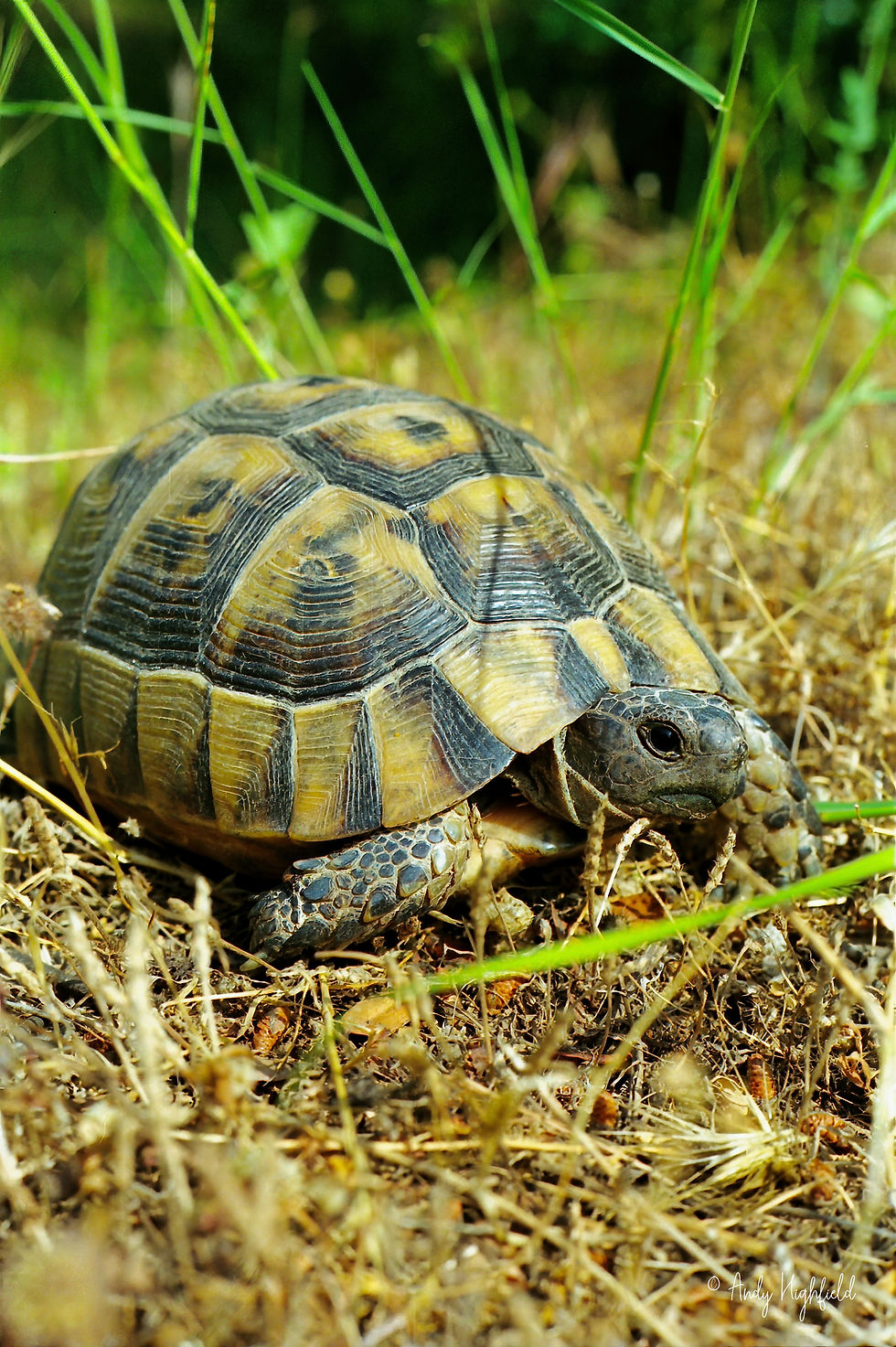
In captivity, however, the story is often very different! A much more limited range of plant foods are provided, and many of these are very unsuitable indeed. Some foods are also notoriously addictive -and most of these also turn out to be the most damaging (see our other article 'Avoiding Dietary Disasters').
If you do have a 'problem' tortoise which is seriously addicted to a narrow-range diet or a particular damaging food item there is nothing for it but to break the habit as soon as possible and get the animal back onto a more natural - and healthier - diet.
The longterm consequences of a bad diet can be truly devastating: shell deformities, damage to internal organs, and eventually, death. So it is absolutely vital to avoid becomming trapped in an unhealthy feeding pattern. See, for example, "Tortoise Shell Deformities: A View from the Inside".
Some tortoises are very resistant to change, however, and will refuse to feed for quite a long time unless offered 'their' food - never give in to this! In the wild tortoises regularly go for long periods without feeding (most 'domestic' tortoises are seriously over-fed compared to their wild counterparts). Offer only healthy and safe foods. Eventually, when hungry enough, the tortoise will take these.
Some keepers have reported that they have tempted food-addicted tortoises to change by squeezing a small amount of juice from the addictive item onto healthier weeds and flowers. It is worth a try, but whatever happens, do not give up and give in.
There is a common misconception that tortoises need to feed almost continuously. Nothing could be further from the truth. In nature their behaviour and feeding patterns are incredibly cyclic, from short periods of plenty to extended periods of very limited food availability and temperature=driven limits upon activity periods, for example, aestivation and brumation (hibernation). This is not a 'negative'. in fact, their metabolisms are perfectly geared to it and it has positive effects upon health growth, for example see our detailed explanation "Unnaturally High Growth rates in Tortoises: Causes and Consequences".
The message is clear:
1) Certain foods are very damaging indeed. Discontinue immediately.
2) If you do not provide them, they can't eat them and they will move over to a healthier diet if that is what you provide instead.
Really, it is that simple.
As you can imagine, conducting genuinely original research takes a very long time to conduct (months and years), involves a great deal of travel, is very time consuming, and also requires the use of some very expensive equipment indeed. If you would like to see more of this, we really would appreciate it if you could make a donation or subscribe. It really helps. We have been established since 1984 and we continue to provide original research and reliable information to tortoise and turtle enthusiasts worldwide. We also have two excellent online courses available, one for beginners and new keepers and one for advanced and professional keepers. These cover some of the background science that is key to truly understanding and appreciating tortoises and turtles and are also extremely practical. We have taught in colleges and universities around the world, and have trained private enthusiasts, wildlife rangers and conservation staff for many years.


